| |
|
Science And
Humanities Engineering About Laboratories :- |
|
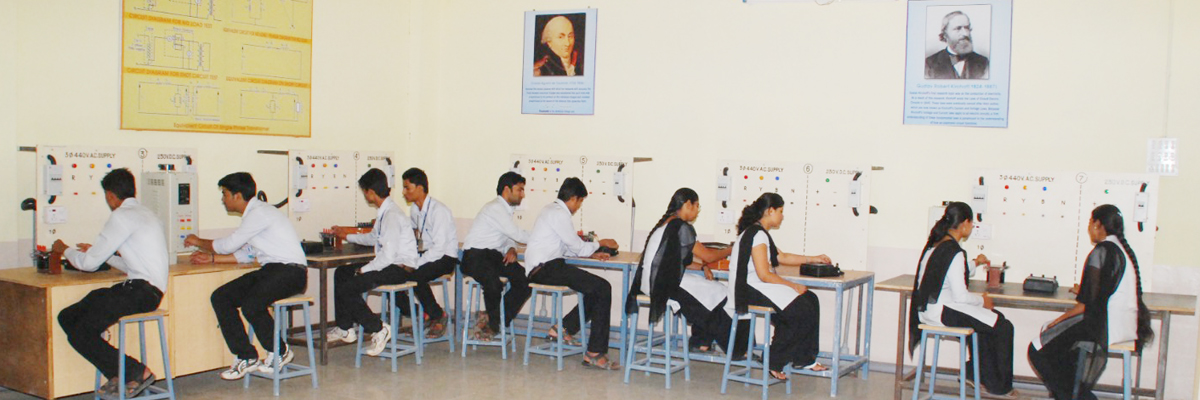
Engineering Physics Laboratory :
Engineering Physics labs (typically 1st year ) focus on
practical application of fundamental physics principles
through experiments in optics, mechanics, electronics,
and materials science. Core experiments involve
diffraction gratings, Newton’s rings, torsional
pendulums, laser characteristics, and semiconductor band
gaps, designed to improve experimental skill. |
|
|
|
Key Lab Procedures
and Guidelines:-
-
Setup &
Recording: Students typically work in
groups, recording observations in a
notebook, and using optical benches or
electrical circuits.
-
Safety & Code:
Circuits must be made with power off,
optical components handled with care, and
results certified by instructors.
-
Documentation:
A complete record with formulas, circuit
diagrams, observations, and calculated
results (e.g., \(E_{g}\) of diode) is
required
This lab enhances
students' problem-solving abilities and circuit
analysis skills, forming a strong foundation for
advanced engineering studies and real-world
applications. |
 |
|
|
|
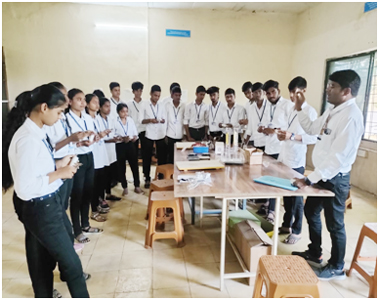
Engineering Chemistry
Laboratory: |
|
|
|
The
Engineering Chemistry Lab provides students with
practical exposure to essential chemical concepts used
in engineering applications. This lab includes
experiments related to water analysis, solution
chemistry, surface chemistry, adsorption, and reaction
kinetics.
Through an interactive virtual environment, students can
perform standard laboratory experiments such as
titrations, hardness determination, surface tension
measurement, and kinetic studies. These experiments help
in understanding real-world chemical processes in a safe
and accessible manner. |
|
|
|
Key Lab Procedures and Guidelines:-
-
Analysis of
resistive, inductive, and capacitive circuits
-
Verification of
network theorems ( Thevenin’s, Norton’s,
Superposition, Maximum Power Transfer, etc.)
This lab enhances students' problem-solving
abilities and circuit analysis skills, forming a
strong foundation for advanced electrical
engineering studies and real-world applications. |
 |
|
|
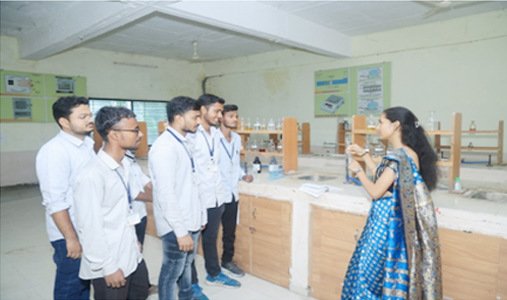
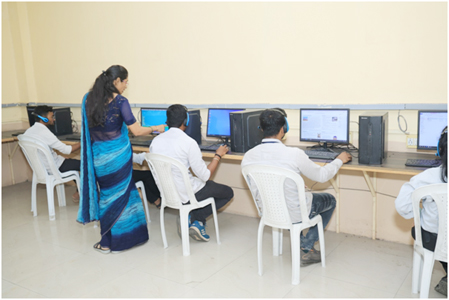
Language Laboratory :
The Language Laboratory is helps student improve
listening, speaking, reading and writing skills in
English though audio-visual aids and interactive
software . |
|
|
|
Key Lab Procedures
and Guidelines:-
-
Pronunciation
and accent through phonetics practical.
-
Listening
comprehension via audio lessons.
-
Confidence in
speaking through recording activities.
-
Performance in
interviews and group discussions
This lab enhances
students' problem-solving abilities and
communication skills for advanced studies and
real-world applications. |
 |
|
|
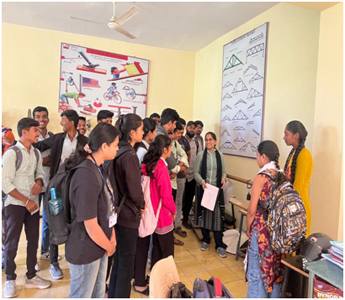
Engineering Mechanics
Laboratory:
The Engineering Mechanics Laboratory is designed to help
students understand the fundamental principles of
mechanics and their applications in engineering
structures and machines. It enables practical learning
of force systems, equilibrium, friction, centroid,
moment of inertia, and mechanical behavior through
experimental analysis and problem-solving techniques. |
|
|
|
Key Lab Procedures
and Guidelines:-
-
Understand the
fundamental concepts of forces, moments,
equilibrium, and friction.
-
Analyze
different force systems and their effects on
engineering structures.
-
Determine
centroid and moment of inertia for various
geometrical sections.
-
Apply
principles of static's and dynamics to solve
engineering mechanics problems.
This lab enhances
students' problem-solving abilities and
communication skills for advanced studies and
real-world applications. |
 |
|
|
|
|